
 Agroaldea
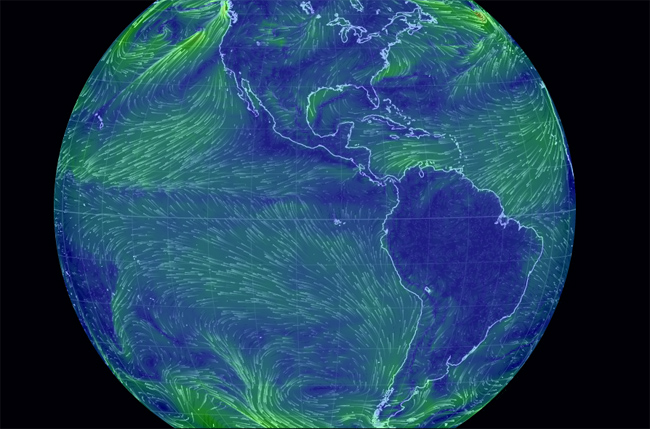 Currently, winds are at a level never before seen in observed records, that extend until the decade of 1860.
New research has found that a rapid warming of the Atlantic Ocean, probably caused by global warming, has given a boost to the trade winds of the Equatorial Pacific.
The increase in these winds has caused the cooling of the tropical Pacific, increasing California drought, United States, raising sea level three times faster than the global average in the western Pacific and slowing the increase in global average surface temperatures since 2001.
Even, may be responsible for 'El Niño' events becoming less common in the last decade due to their impact on cooling sea surface temperatures in the eastern Pacific.
"We were surprised to find that the main cause of Pacific climate trends over the last 20 years had its origin in the Atlantic Ocean”, says lead co-author, Shayne McGregor, del ‘ARC Centre of Excellence for Climate System Science (ARCCSS)' from the University of New South Wales, a Sydney, Australia. “It highlights how changes in climate in one part of the world can have wide-ranging repercussions around the world”, Adds.
Until now, the unprecedented increase in equatorial Pacific trade winds during recent 20 years had baffled researchers. Initially, This intensification of the trade winds was thought to be a response to Pacific variability, but the force of the winds was much more powerful than expected due to changes in the surface temperature of the Pacific Sea.
[quote]Another puzzle from previous research indicates that under global warming scenarios, Equatorial Pacific trade winds will slow down in the next century.[/quote]
The solution lies in the rapid warming of the Atlantic Ocean basin, which has created unexpected pressure differences between the Atlantic and the Pacific, producing wind anomalies that have given an additional boost to the Equatorial Pacific trade winds.
“The rapid warming of the Atlantic Ocean created areas of high pressure in the upper atmosphere over that basin and areas of low pressure near the ocean surface.”, explains Professor Axel Timmermann, co-leader and corresponding author at the University of Hawaii.
"Finally, rising air parcels over the Atlantic sink into the tropical eastern Pacific, creating greater surface pressure there. The enormous pressure seen with high pressure in the Pacific and low pressure in the Atlantic gave an extra boost to the winds in the Pacific, amplifying its strength”, adds.
While active, Stronger equatorial trade winds deal major blow to water in Western Pacific, bringing more atmospheric heat to the ocean, as co-author and ARCCSS Chief Investigator Matthew England showed earlier this year.
This appears to explain much of the recent slowdown in the rise in global mean surface temperatures..
Importantly, researchers do not expect the pressure difference between the two ocean basins to last.. “It will be difficult to predict when the Pacific cooling trend and its contribution to the global pause in surface temperatures will end,” adds England..
However, “A large El Niño event is a candidate with the potential to drive the system to a more synchronized Atlantic/Pacific warming situation.”.