 Agroaldea
THIS IS HOW HE COLLECTS IT “ANALYSIS OF THE CANARY AGROINDUSTRIAL COMPLEX” PRESENTED BY THE CAJA RURAL DE CANARIAS.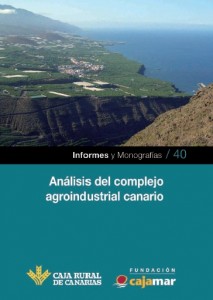
X-ray and orthophoto. This is how the report prepared on Canarian agriculture could be summarized., under the title “Analysis of the Canarian agroindustrial complex” was presented yesterday at the facilities of the Arucas Farm, by the Caja Rural de Canarias.
According to this analysis, by islands, Tenerife dedicates to cultivation 16.903 hectares, Gran Canaria 9.132, La Palma 7.186,7, Lanzarote 3.548, Iron 3.182,8, La Gomera 1.066,9 and Fuerteventura 453, according to the study. It also highlights that agricultural production in 2010 She amounted to 875.126 tons, supported by banana cultivation with a 45,31% of the total and located mainly in Tenerife and Gran Canaria with 326.387 and 312.674 tons, respectively.
The total production value was 455,83 million euros, a 42 % coming from fruits and a 34 % of vegetables. The banana continues to be the most important crop, with a production that generated 130,3 million euros, but the role of the handle is also notable, avocado or papaya, products that gain greater presence year after year, since they are in the expansion phase.
Of the tomato, the 1.691,30 hectares in production, almost all irrigated, of which a 81,6 % is intended for export, grown under shelter and concentrated in Gran Canaria and Tenerife, and that in recent years it has suffered a decline in cultivated area, production and value.
The ornamental flower represents a 1,6 % of the total agricultural area, with a 47,5 % corresponding to wintering, with a production of 12.669 tons and also a downward evolution. The potato is experiencing a similar trajectory as it is grown less and less due to low yields and market pressures..
The wine sector also has an important weight in the primary sector of the Canary Islands., Although in the last decade the surface area has been reduced by 31,4 %, with a parallel evolution of the grape, and has arrived in 2011 to the minimum value since the year 2000.
This has meant that producers have directed their efforts towards productions covered by designations of origin with higher average quality.. just like the potato, the wine is also mainly consumed locally.
Regarding livestock, The report states that the poultry sector is the one that contributes the greatest number of animals, followed by cunicular and porcine. Livestock production and its derivatives are mainly distributed in meat and milk. (33 % each), eggs the 24 % and other products are shared 10 % remaining.
The agri-food industry reached 2010 sales close to 1.189 million euros, a 1,5 % of the national total and a 25 % of the total Canarian industry.