 Agroaldea
THE DOCUMENT REQUESTS THE REJECTION OF THE ASSOCIATION AGREEMENT BETWEEN THE EU AND MOROCCO.
 The Spanish Federation of Associations of Fruit and Vegetable Exporters and Producers (Fepex) subscribed last week, the 'Almería Declaration of the Fepex Tomato Committee', a document in which they request the collaboration of the political class to reject the ratification of the Association Agreement between the EU and Morocco that is expected to be taken to the European Parliament in February.
To do this, They have offered a deadline until the next 20 January so that the presidents of the autonomous communities of Andalusia, Canary Islands, Murcia and the Valencian Community show their position and agreement regarding the Declaration.
The president of the National Tomato Committee of Fepex, José Hernández, declared that the crisis situation that the country is going through, combined with the reduction in generalized consumption, “is not the most appropriate time to make new concessions to third countries that, in the case of Morocco according to the protocol, They would leave the door open for the entry into the European Union of all types of fruit and vegetable products except garlic., and in specific seasons, cucumber, zucchini, clementine, strawberry and tomato -between June and September, in this last case-.
From Fepex they affirm that if the response is not positive it is in the interests of the sector, protest actions will be carried out. The entry into force of the new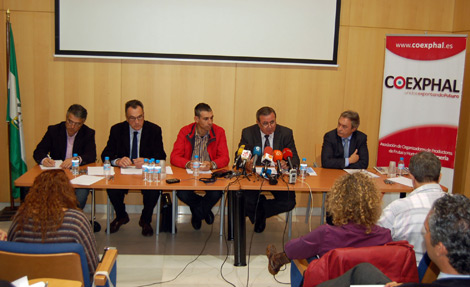 association agreement would have a direct impact on 600.000 jobs, so that a supposed disappearance of the sector would raise unemployment levels to 50 percent, according to your calculations, something that they have described as “hecatombe”.
Only in the tomato sector and in the last year, the agreement in force has caused the destruction of 12.500 jobs, according to the Declaration. By each 1.000 tons of tomatoes that are no longer exported are lost 50 jobs in production areas, issue that “It occurs in autonomous communities that have the highest unemployment rates in the EU”, as estimated from Eurostat data.
THE SUMMITS OF THE TOMATO
José Hernández recognized that the celebration in recent years of two 'Tomato Summits', one in Murcia and another in Almería, in which the agricultural councilors of the aforementioned communities showed their support for the sector,They have been of no use so far., Therefore, on this occasion, the necessary support has been requested from the presidents of the autonomous communities..
According to the 'Almería Declaration of the Fepex Tomato Committee', subscribed by the associations of exporting producers of Andalusia (Coexphal), Murcia (Proexport), Valencian Community (Fexphal) and the Canary Islands (FedEx and balsamic), the export of tomatoes from Morocco to the Saint Charles market, in Perpignan, France, “has quadrupled the Spanish figure in the month of October and has quintupled in November”, which for Fepex means that Morocco “has expelled the Spanish tomato from what has been its traditional and main market”.
The increase in exports also occurs, “breaching the Agreement with the EU” Since, in october. Morocco “exceeded what was established in the agreement 120 percent and in November a 37 percent”. They also assure that “entry prices have not been respected either, established in the agreement and in the World Trade Organization (OMC) to avoid low-priced imports that destabilize the EU market”.
They thus defend that the new association agreement, pending ratification by the European Parliament, “will aggravate this situation, since it practically liberalizes the export of Moroccan fruits and vegetables”. During the period of the Moroccan tomato preferential quota, from october to may, Spain performs the 90 percent of its shipments and the Maghreb country 95 percent. “If tariff protection is not maintained and social clauses are not established, Morocco will expel from the market Spanish producers who cannot compete with wages of 60 cents/hour”.
THE DECLARATION
Given this unsustainable situation, the FEPEX Tomato Committee, composed of the associations of exporting producers of Andalusia (COEXPHAL), Murcia (PROEXPORT), Valencian Community (FEXPHAL) and the Canary Islands (FEDEX y ACETO),
request:
1. That the European Parliament returns to the Council and the Commission the Agricultural Protocol of the Association Agreement with Morocco, pending ratification, for the Commission to carry out a prior analysis of the social and economic impact on the Spanish fruit and vegetable sector and the entire Mediterranean community agriculture, as well as for social clauses to be included.
2. That the Spanish political parties establish a common position before the community institutions demanding the review of the Agricultural Protocol of the Association Agreement and that they work actively so that said Protocol is rejected by the Plenary of the European Parliament under the current conditions.
3. That the European Commission applies what is established in the Agreement in force, especially regarding:
- Entry prices and non-payment of customs duties, which is causing a serious crisis in the markets and serious damage to the community budget.
- The European Commission should listen to the European Parliament, to the different EU institutions, studies, etc. that recommend the reform of the entry price system:
Year 2006. The Special Corps of Inspectors of the Commission prepared an audit report on the application of the Regulation (CE) number 3223/94 on the import regime, released in September 2006, which confirmed the existence of multiple irregularities.
-
Year 2007. OLAF report “CMS number 0F/2004/015 of 16 November 2007” in which the existence of irregularities in the importation of tomatoes from Morocco is confirmed, investigation that began after a complaint filed by FEPEX in 2004.
-
Year 2008. The Directorate General of Agriculture and Rural Development of the European Commission commissioned a study on the evaluation of the entry price system in the fruit and vegetable sector. In July 2008 conclusions were published that recommended the reform of entry prices
-
Year 2011. The Petitions Committee of the European Parliament asked the European Commission, the 7 April, to reform the entry price system and said: “Can the Commission explain why it has not taken any measures to modify the entry price regime for tomatoes in order to put an end to these abusive practices highlighted by OLAF?? Does the Commission not consider that it should make these changes without delay?, taking into account that the new agricultural chapter of the Association Agreement with Morocco foresees an increase in tomato imports to the EU?”.
4. Application of the safeguard clause, collected in the article 25 of the Association Agreement and in article 6 of the Protocol in force, in order to overcome the crises caused by imports from Morocco. The article 6 states that “Without prejudice to the remaining provisions of this Agreement, and, due to the special sensitivity of agricultural markets, Imports of products originating in Morocco that are the subject of concessions granted under this Protocol cause serious disturbance of Community markets in the sense indicated in Article 25 of the Agreement, The Parties will immediately begin consultations with a view to finding an appropriate solution. Until a solution is reached, "The Community may adopt the measures it deems necessary.".
5. Opening of an antidumping investigation procedure for tomato imports from Morocco, in a double social and economic aspect. On the one hand, salary costs cannot be accepted in Morocco 60 cents/hours under conditions of free access to the community market. And on the other hand, at the current prices at which Moroccan tomatoes are being marketed, and once transportation and marketing costs have been deducted, Settlements to Moroccan farmers are even below their production costs.