 Agroaldea
The European Commission has done it again. With a diplomatic smile, future-oriented rhetoric and well-designed communications, has approved the agreement with Mercosur. A “historic” pact, “strategic” and “necessary”, according to the official argument. All that... except for the European primary sector, which once again takes its usual place at the community table: that of currency.
Because when you have to choose between steel, chemical, pharmaceutical, industrial or automotive exports, and agriculture, livestock and fishing, the balance does not doubt. The field gets in the way. The field, bothers. The field is sacrificed. And it is done with astonishing naturalness, like we're not talking about food, territory, employment, landscape and sovereignty.
The agreement with Mercosur responds to a logic as simple as it is stark: Europa amplía sus exportaciones de vehicles, machinery, pharmaceuticals, oil, wines and alcoholic beverages en un contexto de tensiones comerciales globales. In exchange, abre sus fronteras a productos agrícolas del Mercosur como meat, sugar, rice, honey and soy.
A clean exchange… on paper. In practice, supone inundar el mercado europeo con productos cheaper, from countries with environmental regulations, labor and health standards well below those required of European producers. “Free” competition, they call her. Free of controls, free of costs and free of responsibilities.
In the meantime, the European farmer is required to produce more, with less, meet increasingly strict standards and sell at prices that do not even cover costs. And when you raise your hand, responds with strategic plans, institutional campaigns and some well-intentioned slogans.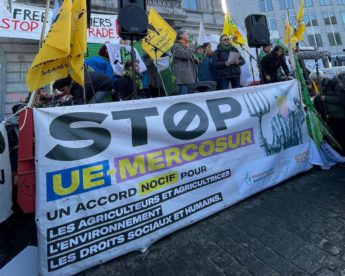
To wash the conscience, incorporate safeguard clauses that “seek to balance the benefits of the agreement with the need to protect EU farmers from greater competition”, as if they were going to fulfill them. We already know them from the preferential trade agreements with third countries in the Mediterranean basin.
The sector's concern is not ideological, ES mathematics. No se puede competir contra carne producida con transgenic soy, phytosanitary treatments prohibited in the EU and production models that would be directly illegal here. Soybeans - and many cereals- that is grown in these countries is mostly transgenic; cattle feed on it; The treatments used are not authorized in Europe. But the product enters. Without complexes. And you will consume it without saying a word. Why, probably, you're not even going to find out.
They understand why China's excessive tariffs on electric vehicles. Because it directly affects the European industry and that, en esta Europa “solidaria” no se puede permitir. Those of us in the primary sector are something else...
The regulatory asymmetry between both blocks is so evident that it is difficult to believe that anyone would defend it in good faith.. And still, moving forward. Because the problem has never been coherence, but place industrial surpluses and ensure markets for large corporations.
Italy, who until recently frowned, terminó apoyando el acuerdo tras la promesa de la Comisión Europea de poner sobre la mesa 45.000 additional million euros for the CAP from 2028, within the new multiannual financial framework. France, thanks to the pressure of its farmers and ranchers in the streets, recanted with Ireland, Austria, Poland and Hungary. Belgium abstained. A “we'll see” wrapped in future figures, perfecto para desatascar un voto hoy y dejar las consecuencias para mañana. Classic.
If the impact is serious on the continent, en Canarias es doubly wicked. Here we are not only talking about unfair competition, but of territorial survival in an outermost region with structural extra costs, foreign dependence and an already fragile primary sector. Each farm, Each hectare that is abandoned or closed is not only production that is lost: It is a landscape that disappears, job that does not return, territory that is degraded and food dependence that increases. Every farmer who leaves is a more fragile food system. But yes: then the institutional campaigns will come, emotional videos and speeches about responsible consumption.
As icing on the cake, the EU-Mercosur agreement It is also sold as compatible with climate objectives, although the studies themselves recognize the opposite. The increase in the volume of production in certain sectors – both in the EU and in the Mercosur countries – will imply, inevitably, more sea and air transport, more kilometers traveled and more greenhouse gas emissions. I.e., more CO₂ to be able to continue talking about sustainability in speeches. An agreement that encourages trade thousands of kilometers away can hardly square with climate legislation that, on paper, boasts of reducing the carbon footprint and protecting natural sinks.
It is no coincidence that environmental and social organizations warn that the agreement is incompatible with the Agenda 2030 and international climate commitments. Agricultural and livestock expansion in Mercosur countries, deforestation —especially in the Amazon— and the absence of binding mechanisms that guarantee environmental and social compliance turn the treaty into an emissions accelerator, not in a mitigation tool. The EU-Mercosur agreement does not protect the climate: outsources it. Move the environmental footprint outside of Europe to continue proclaiming green objectives from Brussels, while emissions increase and forests disappear far from the spotlight… but very close to the consequences.
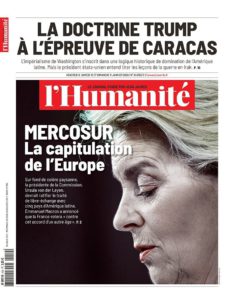
It is worth saying it loud and clear: This is not just about farmers and ranchers.. Va de what do we eat, where does it come from, with what controls and how much dependence we are willing to assume. Less primary sector means more imports, less quality, less control and more vulnerability. It means accepting that food sovereignty is negotiated at the same level as a car tariff.
And while all this was being negotiated against the clock in Brussels, The Parliament of the Canary Islands distributed its traditional Christmas bonus. Basket contents? Not a single product produced or manufactured in the Canary Islands. Not one.
We must remember that your honors, seventy, they charge on average about 5.500 monthly euros, with diets that have gone from 904 to 2.087 EUR, while severe poverty affects more than 225.000 canaries that survive on less than 664 euros per month. And so that it would not be so hard to chew, Parliament itself removed the deputies' allowances from its website after the controversy over its increase..
Todo ello mientras la Consejería del ramo lanzaba la campaña "Canary Islands, pantry of the Atlantic”, appealing to responsible consumption and support for the primary sector. The most striking thing was not the basket. Fue que no one returned it como gesto de protesta. Not one. Because the message is clear: Consuming canary is very good... as long as it does not mean giving up anything. We have what we deserve. In France it surely wouldn't have happened. You will have to see who were the inventors of the guillotine.
The agreement with Mercosur is not an isolated event. It's a way of governing. A way of understanding development in which the countryside always pays the bill, The industry reaps the benefit and coherence remains in the discourse. These agreements do not benefit the local population. They benefit whoever controls the volume, price and logistics. The rest, adapt or disappear.
The problem is not only that the primary sector is tired. The problem is that society has not yet understood that when the field is liquidated, the past is not lost: future is lost. We reiterate, less primary sector means less local production, more imports, less control and more vulnerability. It means accepting that food sovereignty is negotiated at the same level as a car tariff.
so yes, the agreement is a success. But it should be said clearly and bluntly.:we all lose, except the big corporations. If you think it's not your problem, then you have a big problem.