
 Agroaldea
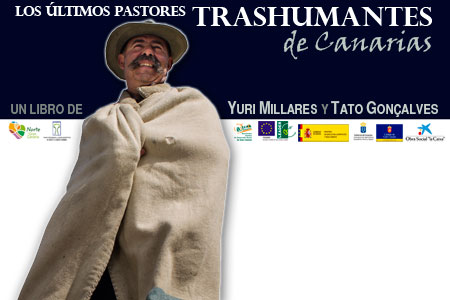 THE WORK OF YURI MILLARES AND TATO GONÇALVES, PORTRAYS IN WORDS AND IMAGES THE 18 LAST TRASHUMANTS.
The journalist and researcher Yuri Millares, who had already published an extensive report on the subject a few years ago, points out that “in Gran Canaria, when making a new count of shepherds who still practice transhumance, The resulting list numbers them in 18, after adding some that I missed in 2006 and to delete many others that, due to various circumstances, they are not moving the cattle”.
Millares adds that once “the list of remaining transhumants has been established, The story that follows is the photograph of the visits we have made (accompanied half of the time by Isidoro Jiménez, who served as a road guide, tracks and roads on the island to locate them)”.
“It is not about – he indicates –, from a study on transhumance, but rather a close portrait of its protagonists, both in words and in the images contributed by whoever has accompanied me this time: photographer Tato Gonçalves.
And they do not follow one another on the pages following a geographical order., nor alphabetical, nor by statistical criteria or routes followed. They are there composing a story that tries to maintain a balance of intensities (in words and images), in favor of the reader's interest in going through each and every page with interest until the end.".
 The prologue of the book, by the master cheesemaker Isidoro Jiménez, it puts the reader in the situation, explaining that “with the conquest, "The pastoral culture of the Canary Islands was integrating elements from other places in the world and techniques from other places were intertwined with the traditional herding scheme, resulting in very complex and specialized pastoral strategies.".
For this reason, dice, “In the case of Gran Canaria there are basically, as in many other social and environmental aspects, two different cultures: the south, mainly goatherd, facing a North where grazing is mostly sheep.
In both cases the pastoral technique was basically transhumant from coast to summit., grazing the flocks in the low areas in the winter and ascending to the mountain pastures in summer and autumn to return to the low-lying corrals in the calving season.".
“Currently,” he adds,, although the goatherds in the south and east of the island continue to maintain large flocks, they use grasses less and less as a food resource, so cattle movements have been reduced, in general, to the surfaces closest to the pens; However, in the northwest area and on the summit of the island there are sheep shepherds who not only move their flocks daily looking for the best pastures., "But they even have corrals in different areas depending on the time of year.".
Without a doubt, an essential work.