 Agroaldea
 DIFFERENCES WITH THE EUROPARLIAMENT WILL BE RELIED.
Includes raising the 75 to the 85 percent the European co-financing rate for Rural Development Programs, in less favored areas and for the outermost regions, including the Canary Islands, as required by the European Parliament.
The Ministers of Agriculture of the European Union have agreed this Monday on a revised mandate to overcome the divergences that separate them from the European Parliament on issues of the new Common Agricultural Policy (PAC) such as the aid ceiling and the transfer of funds. The objective is to overcome the last obstacles that keep the final confirmation of the agreement announced last June blocked..
“The Council has obtained broad agreement from “the 28” for a slightly modified mandate. I hope to reach an agreement”, declared the Lithuanian Minister of Agriculture and acting President of the EU Council, Vigilius Jukna, in a public session with his European colleagues.
Jukna informed the ministers that, after a day of discussions, has seen a “possible compromise” What “represents a minimum for the European Parliament, but at the same time, a maximum for the Council”.
This formula includes raising 75% to the 85% the European co-financing rate for rural development programs for less favored areas and for ultra-peripheral regions, including the Canary Islands, as required by the European Parliament. This option will be optional for Member States, not mandatory.
Several of the Member States, including Poland, The Czech Republic and Hungary took the floor to speak out against this idea because it contradicts what was agreed by the heads of state and government of the EU last February.. But they have decided to abstain and not vote against the mandate to favor a global agreement.
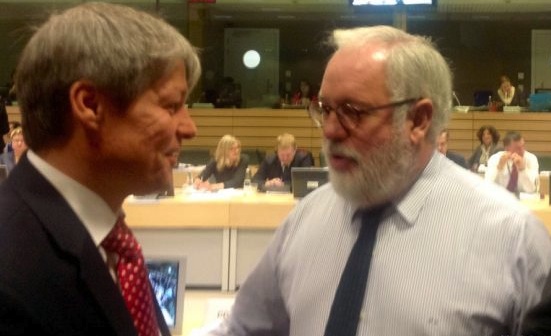
At the end of the negotiation day 28 in Brussels, the Spanish Minister of Agriculture, Miguel Arias Canete, highlighted the “flexibility exercise” of the Member States to “approach” to the European Parliament.
In particular, has highlighted the co-financing raised to 85 % for ultra-peripheral regions and most disadvantaged areas because, if this point is confirmed, “does not involve more community spending, but less national spending”.
With it, has emphasized, they realize “more possibilities for the autonomous communities to be able to finance projects, without risk of loss of community funds” and has put Extremadura as an example of the regions that could benefit from this measure, for not reaching 75 % of GDP per capita.
The agreed mandate is “positive” for Spain because it respects their requests, said Arias Cañete, and because it represents an offer “balanced” to seek consensus with the European Parliament.