 Agroaldea
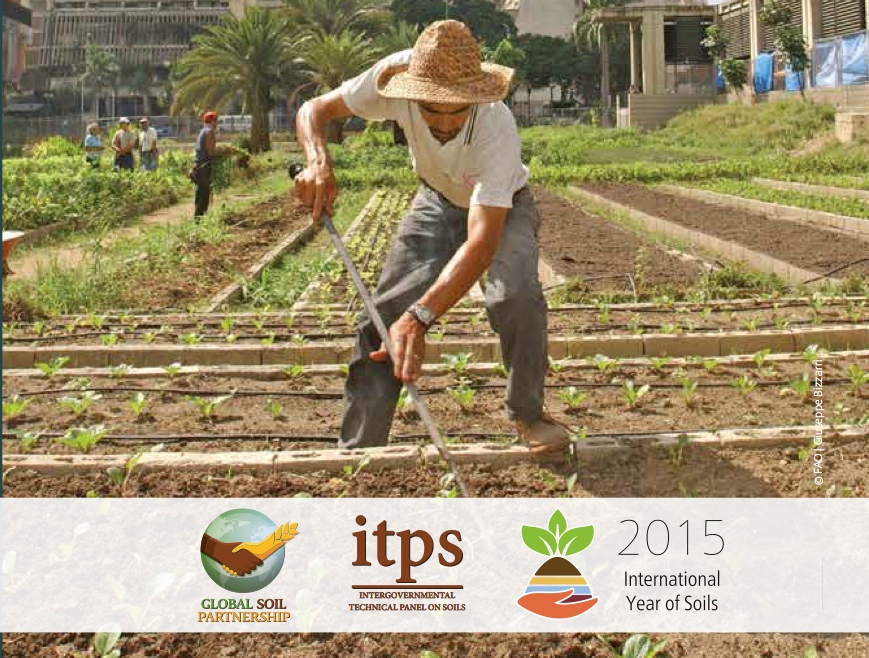 Population growth, Industrialization and climate change threaten soil health.
The world's soils are deteriorating rapidly due to erosion, nutrient depletion, organic carbon loss, soil sealing and other threats, but this trend can be reversed as long as countries take the initiative in promoting sustainable management practices and the use of appropriate technologies., according to a new report de la HIM.
The state of soil resources in the world, prepared by the FAO Intergovernmental Technical Group on Soils, brings together the work of some 200 soil scientists 60 countries. Its publication coincides with World Soil Day - which is celebrated on 4 of December- and also with the closing of the International Year of Soils 2015 de la HIM, an initiative that has served to raise awareness worldwide about the so-called “silent ally of humanity”.
“Let us promote sustainable land management based on adequate governance and rational investments. Together we can advance the cause of soils, that constitute a truly solid foundation for life”, said the UN Secretary General, Ban Ki-moon in a message on the occasion of World Soil Day.
Soils are vitally important for the production of nutritious crops and They filter and clean tens of thousands of km3 of water every year. As an important carbon store, Soils also help regulate emissions of carbon dioxide and other greenhouse gases, being therefore fundamental for climate regulation.
However, The overwhelming conclusion of the report is that Most of the world's soil resources are in poor or very poor condition. and that conditions are getting worse in many more cases than they are improving. In particular, the 33 percent of the land is moderately to highly degraded due to erosion, salinization, compaction, acidification and chemical contamination of the soils.
“Further losses of productive land would seriously damage food production and food security, expanding food price volatility, and potentially plunging millions of people into hunger and poverty. But the report also offers evidence that this loss of soil resources and functions can be avoided.”, noted the Director General of FAO, José Graziano da Silva.
In his prologue to 650 report pages, Graziano da Silva expressed the conviction that the content “will go a long way to galvanizing action at all levels towards more sustainable soil management”, adding that this was in line with the international community's commitment to achieving the Sustainable Development Goals.
Changes in soil condition are mainly driven by population growth and economic growth, factors that are expected to persist in the coming decades.
The report points out the need to feed a world population that has grown today to nearly 7.300 millions of people, and that more than 35 percent of the planet's ice-free land surface has been devoted to agriculture. The result is that soils that have been cleared of natural vegetation for growing crops or grazing livestock suffer sharp increases in erosion and large losses of soil carbon., nutrients and biodiversity.
In addition, urbanization is paying a high price. The rapid growth of cities and industries has degraded increasingly large areas, with the contamination of soils with excess salt, acidity and heavy metals; compaction with heavy machinery; and permanently sealed under asphalt and cement.
Climate change - currently the focus of the UN COP21 conference in Paris- is an important additional reason for soil transformation, according to the report.
Higher temperatures and related extreme weather events, like droughts, floods and storms, impact soil quantity and fertility in various ways, among them reducing humidity and depleting the arable layers rich in nutrients. They also contribute to an increase in the rate of soil erosion and the retreat of coastlines..
Achieve healthy soils
The report focuses on the 10 main threats to soil functions: erosion, organic carbon loss, nutrient imbalance, soil acidification, pollution, waterlogging, soil compaction, sealed, salinization and loss of soil biodiversity.
It is also explained that there is a general consensus on land-related strategies that can, on the one hand, increase food supply, and on the other, minimize harmful environmental impacts.
The proposed solution is one that focuses on sustainable soil management and requires the high participation of interested parties., ranging from governments to small farmers.
erosion, for example, can be contained by reducing or eliminating tillage-digging, remove and turn the soil- and the use of crop residues to protect the soil surface from the effects of rain and wind. In the same way, Soils suffering from nutrient deficiencies can be restored and yields increased by returning crop residues and other organic materials to the soil., using crop rotation with nitrogen-fixing crops, and making judicious use of organic and mineral fertilizers.
The report identifies four priorities for action:
Minimize further soil degradation and restore the productivity of already degraded soils in regions where people are most vulnerable;
Stabilize global reserves of soil organic matter, including both soil organic carbon and soil organisms;
Stabilize or reduce global consumption of nitrogen and phosphorus fertilizers, in addition to increasing the use of fertilizers in nutrient-deficient regions; and,
Improve our knowledge of the status and trend of soil conditions.
These actions need to be supported by well-targeted policies., including:
Support for the development of soil information systems to monitor and forecast soil changes; Increased education and awareness in the field of soil, integrating it into formal education and curricula: from geology to geography and from biology to economics; Investment in research development and extension, to develop tests, disseminate sustainable soil management technologies and practices; Introduction of appropriate and effective regulation and incentives.
This could include taxes that discourage harmful practices, such as excessive use of fertilizers, herbicides and pesticides. Zoning systems can be used to protect prime agricultural land from urban sprawl. Subsidies can encourage people to buy tools and other inputs that have a less harmful impact on soils, while certification of sustainable agricultural and livestock practices can lead to more commercially attractive products with higher prices;
Supporting the achievement of food security at the local level, regional and international, taking into account the land resources of the countries and their capacity to manage them sustainably.
Some of the main conclusions of the report:
Erosion takes place 25 to 40 000 million tons of topsoil each year, significantly reducing crop yields and the soil's ability to store and cycle carbon, nutrients and water. Annual losses in cereal production due to erosion are calculated in 7,6 million tonnes. If measures are not taken to reduce erosion, Projections indicate a production reduction of more than 253 million tons in 2050. This performance loss would be equivalent to removing 1,5 million square kilometers of agricultural land, or approximately all the arable land in India.
Lack of soil nutrients is the biggest obstacle to improving food production and soil function in many degraded landscapes. All African countries - except three- They extract more nutrients from the soil each year than are returned through the use of fertilizers, crop residue, manure and other organic matter.
The accumulation of salts in the soil reduces crop yields and can completely eliminate agricultural production. Salinization caused by human activity affects some 760.000 square kilometers of land around the world: an area larger than the entire arable area in Brazil.
Soil acidity is a serious obstacle to food production around the world. The most acidic arable layers in the world are found in areas of South America that have suffered deforestation and intensive agriculture.