 Agroaldea
 A GOOD PART OF THE LABELING OF AGRICULTURAL PRODUCTS IS CONFUSING OR “PARANORMAL”.
Take a walk around the supermarkets or large stores on the island and stop at the signs that announce the offers and details of them., is becoming a task that some define as “the hunt for the rabbit”. But, is it a blunder, consumer deception or lack of control?.
It is not the first time that it has happened that products supposedly from the Canary Islands or from the Canary Islands, are supplanted by others of unknown origin or that in the labeling “surrealistically” its origin is reported while it is sold as “canary”.
But what happens with the distribution and sales channels??. A priori, We start from a series of gaps in the regulations and legislation on the marketing of Canarian products.. Some have protected names, very few Protected Geographic Identifications, IGP y, at the end, It is the local consumer who knows their local products and tries to look for them.
Teror chorizo made in Italy and placed in Gran Canaria with the label “of Terror”, is it a fraud?. Common sense tells us yes.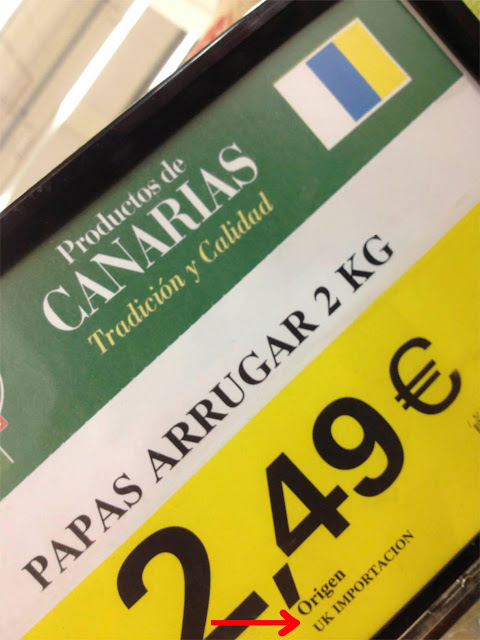 But current regulations override common sense..
There is a mandatory rule that establishes minimums in the labeling of products. For some years now the origin has to appear, but who is in charge of guaranteeing that the origin, whose typography is always much smaller, do not confront with the local product?
This practice points to a defenselessness of the consumer who believes they are buying the local product when they are really purchasing the one made or harvested elsewhere..
Agroaldea consulted those responsible for Consumer Affairs about this “double labeling” and the answer has been that “although it does not seem logical, there are no regulations, about some products, that prevents it”.
And we come to the big question: Are local products and productions protected from being supplanted by those produced elsewhere??
Are the initiatives that have been carried out in the Canary Islands sufficient to protect some of the products produced here??
The next time you go shopping, look for local, take the common sense test by reading your label…
This news has been complemented with photographs that illustrate  “potatoes to wrinkle” product of the Canary Islands and origin in the U.K.; Canarian Tomato whose origin is Almería and Banana variety Gran Canaria and its origin Ivory Coast.