 Agroaldea
 THEY STATE THAT THEIR EXCLUSION “IT PUTS VALUABLE NATURAL AND CULTURAL SPACES AT RISK”.
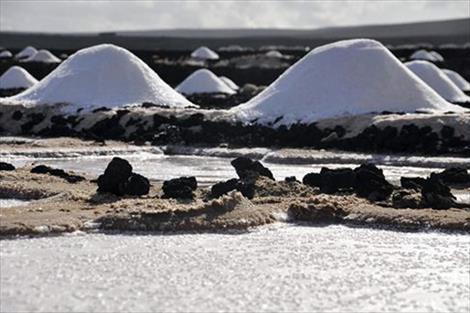
Salinas de Janubio has addressed the General Directorate of Agriculture and Rural Development of the European Commission requesting the inclusion of artisanal sea salt, obtained by traditional methods, in the regime of the Specific Options Program for Remoteness and Insularity (POSEI), which is in the public consultation phase for review.
The reason is that sea salt produced in traditional sea salt mines using artisanal techniques (sol, wind, Atlantic Ocean seawater engineering, original layout…) “they are very labor intensive and barely admit mechanization because, at least in the Canary Islands, They are usually part of the network of protected natural spaces, well are protected by the figure of Assets of Cultural Interest (and alterations to these spaces are not permitted.)”.
For this reason, They request that it be included in the list of products that receive aid from POSEI, setting its amount based on the kilograms produced, the cultivated area, the direct employment generated and the quality and level of demand of the environmental management implemented, since it is transcendental for the survival of these spaces.
Following the recent visit to the Canary Islands by the European Commissioner for Agriculture and Rural Development, Dacian Ciolos, A public consultation has been launched on the aspects, criteria and objectives that should govern the review of European funds for the period POSEI 2014-2020. In this consultation, Interested parties are invited to express their opinion on the POSEI review.
Artisanal sea salt mines located in the ORs that obtain salt through traditional methods are excluded from POSEI, Between other reasons, due to the lack of legislative uniformity between the member countries of the European Union, despite being considered an agri-food product by the Union.
As sea salt produced in the ORs using traditional methods is excluded from POSEI aid, “Valuable natural and cultural spaces are put at risk.”, as well as a production with deep historical roots, “with high employment potential and capable of supplying a large part of the Canarian domestic market”.
According to Salinas de Janubio, The inclusion of artisanal sea salt in the POSEI regime “would allow us to deepen food self-sufficiency in the ORs.”, attract young people to the primary sector, promote employment and guarantee sustainability while preserving the environment and territorial balance”.
The Janubio Salt Flats have a historical average annual production of 10.000 tons -optimal production-. The current production is about 2.000 tons, approximately.